Spacewalk Survival

Raghu Yadav
| 11-08-2026
 · Science Team
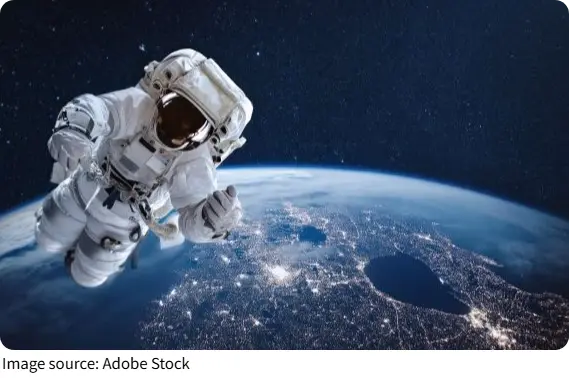
Imagine opening a spacecraft hatch and moving into a place with no air, no ground, and no sound. Below us, Earth would look peaceful and distant, while every movement outside the spacecraft would require careful control.
A spacewalk may look beautiful in photographs, but it is also one of the most carefully planned tasks in space exploration.
When astronauts leave their spacecraft, they depend on their suits, communication systems, safety equipment, and training. A small equipment problem can become serious because there is no ordinary environment around them to provide support.
Why Movement Is Different
In space, astronauts cannot walk as we do on Earth. They move by holding handrails, using footholds, and gently pushing against prepared surfaces. A simple push can change their direction, so every movement needs attention.
Astronauts usually remain connected to the spacecraft with safety tethers. These lines provide an important layer of protection if an astronaut loses contact with a handrail. Some missions also provide emergency propulsion equipment that can help an astronaut return toward the spacecraft.
Without such systems, an astronaut who drifts away would have very limited ways to change direction. Space has no solid surface that can be used to turn around or stop.
The Suit Protects Life
A spacesuit is not simply protective clothing. We can think of it as a small personal life-support system. It provides oxygen, removes carbon dioxide, helps control temperature, and maintains pressure around the body.
The vacuum of space is extremely different from Earth's atmosphere. If suit pressure is suddenly lost, moisture within exposed body tissues can begin to vaporize because the surrounding pressure is extremely low. This makes a damaged suit a serious emergency.
The suit also contains several protective layers. These help manage temperature changes and provide some protection from tiny particles moving through space.
Extreme Heat and Cold
Space can create unusual temperature conditions. In direct sunlight, surfaces can become very hot, while areas in shadow can become extremely cold. There is no surrounding air to spread heat in the same way as on Earth.
To manage this, spacesuits contain thermal control systems. Cooling systems circulate liquid around the astronaut's body, helping carry away excess heat produced during physical work.
This is especially important because spacewalks can last for several hours. Astronauts may be working with tools, moving equipment, or repairing spacecraft components while wearing a suit that limits natural movement.
Radiation Exposure
Earth's atmosphere and magnetic field provide important protection from space radiation. Outside a spacecraft, astronauts receive greater exposure because much less shielding surrounds them.
A short spacewalk does not usually mean an immediate health problem from radiation. However, exposure can add to long-term health concerns, so mission planners carefully manage how long astronauts remain outside.
The timing of a spacewalk is also considered carefully. Space agencies monitor conditions and select suitable periods for outside work whenever possible.
Tiny Objects, Huge Speed
Another challenge comes from small particles traveling at very high speeds. Natural particles and human-made debris can move quickly enough to damage spacecraft surfaces and protective equipment.
Even an object that looks tiny from a distance can carry significant energy when traveling at orbital speed. A collision with a spacesuit could damage one or more protective layers and create a dangerous pressure problem.
For this reason, space agencies track known objects in orbit and consider their paths when planning missions. Protective suit materials also help reduce the chance of damage from small impacts.
Breathing Is a Constant Task
Inside a spacesuit, the breathing system works continuously. Astronauts use oxygen while their bodies produce carbon dioxide. The suit needs to supply fresh oxygen while removing the unwanted gas.
If either process develops a serious fault, the astronaut can quickly become uncomfortable and lose the ability to work normally. Training therefore includes equipment checks, warning signals, communication procedures, and emergency responses.
Astronauts practice these situations before missions so that important actions become familiar rather than confusing during a real emergency.
Why Rescue Takes Planning
On Earth, help can often arrive quickly. During a spacewalk, rescue is far more complicated. There is no nearby road or open area where another team can simply reach the astronaut.
Because of this, prevention is central to every mission. Before leaving the spacecraft, astronauts inspect equipment, test communication, check safety connections, review procedures, and plan their movements.
The goal is to prepare for problems before they happen. Careful planning gives the crew more options if equipment behaves unexpectedly.

Returning to Safety
When the work is finished, astronauts carefully move back toward the spacecraft. They secure tools, check their connections, enter through the hatch, and complete the planned procedures before removing their equipment.
Lykkers, the next time we see an astronaut floating above Earth, we can look beyond the amazing view. Every movement represents training, engineering, teamwork, and careful preparation. Spacewalking reminds us that exploration is not only about reaching new places. It is also about learning how to work safely in an environment completely different from our own. Which part would challenge you most: moving without gravity, managing the suit, or working so far above Earth?