The Art of Road Design

Arvind Singh
| 26-08-2026
 · Art Team
Roads are essential parts of the built environment, connecting neighborhoods, cities, and landscapes.
Beyond moving people efficiently, their geometry, structures, materials, lighting, and planting can shape how a place looks and feels.
From a quiet residential street to a major interchange, good transportation design combines practical performance with a clear visual identity. Because roads are experienced while moving, their design unfolds through a changing sequence of spaces and views.
Roads as Designed Spaces
A roadway is more than pavement. Its width, alignment, sidewalks, crossings, lighting, planting, and relationship with nearby buildings all influence the experience.
Residential streets may use trees and smaller-scale elements to create a comfortable setting, while larger urban corridors can use stronger geometry, wider pedestrian areas, and coordinated lighting.
Geometry and Movement
Straight roads create long perspectives, while curves guide movement and reveal new views. Intersections introduce more complex patterns as routes meet and change direction.
Roundabouts add circular geometry while creating opportunities for central landscaping. These features show how traffic organization can also contribute to visual composition.
Highways and Bridges
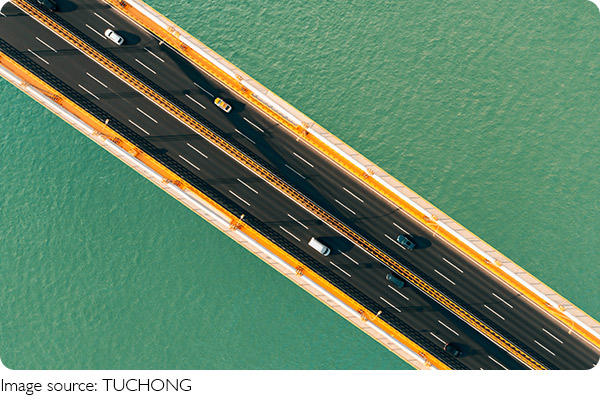
Highways bring transportation design to a larger scale. Ramps, tunnels, elevated sections, retaining structures, and interchanges create complex forms across the landscape.
Bridges combine structural performance with visual expression. Their proportions, materials, supports, and relationship with the surroundings can turn a necessary crossing into a memorable architectural feature.
Intersections and Road Markings
Intersections bring traffic lanes, crossings, signals, sidewalks, bicycle facilities, signs, and planting together in a limited space. Clear organization improves movement while creating visual order.
Road markings contribute to this structure as well. Lane lines, arrows, crossings, and turning zones create repeated geometric patterns across the pavement while serving essential practical functions.
Lighting and Landscape
Lighting changes the character of a roadway after sunset. Well-positioned illumination can define edges, emphasize curves, improve visibility, and highlight bridges or pedestrian areas.
Landscape provides another important connection with the surrounding environment. Trees, planting, terrain, and open spaces can soften large paved areas, frame views, and create transitions between infrastructure and nature.
Experiencing Roads in Motion
Unlike a static building, a road is experienced continuously while people move through it. A curve can reveal a new building, a bridge can frame the sky, and trees can create a repeating sequence of views.
This changing perspective gives transportation design a distinctive quality: the environment becomes a visual journey rather than a single scene.
Where Engineering Meets Art
The strongest road designs combine function with visual clarity. A curve can guide traffic while creating an elegant perspective. A bridge can meet structural demands while becoming a landmark. A roundabout can organize movement while incorporating a carefully planned landscape.
When geometry, structure, materials, landscape, and movement work together, infrastructure can become both efficient and visually compelling.
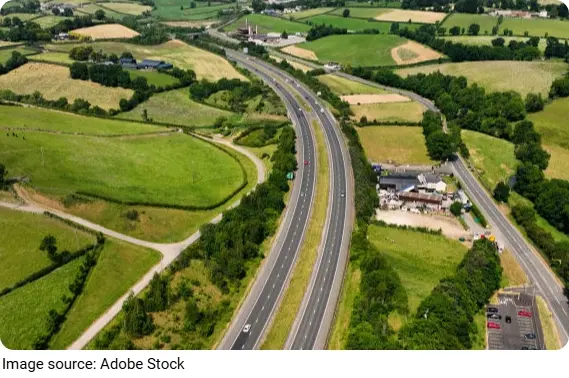
Road design extends far beyond highways. Streets, bridges, intersections, roundabouts, and transportation corridors all shape the character of the built environment.
The art of road design lies in making infrastructure function efficiently while creating spaces that are clear, cohesive, and visually engaging.