Oversized Knits: Right Fit

James Carter
| 27-08-2026
 · Lifestyle Team
Hi there, readers. You see a chunky knit on a rack, grab your usual size, and end up swimming in it.
Or you size down to avoid the bulk and lose the whole relaxed point. The trick isn't about your normal size at all.
It's about two specific spots on your body: your shoulders and where the hem hits.
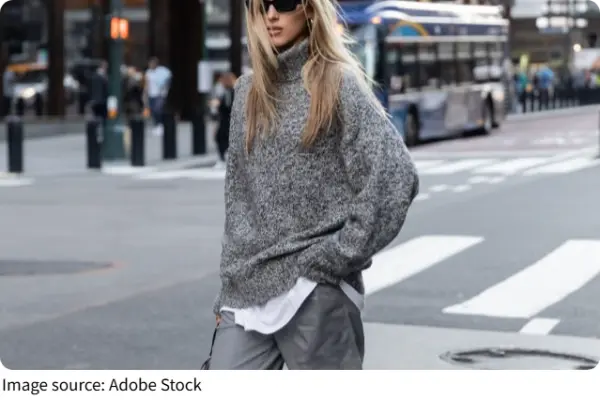
Shoulders decide the whole look
The fastest way to tell if an oversized knit works is to check the shoulder seam. If it sits right on your natural shoulder line, that's not oversized, that's just a regular fit with extra fabric. You want the seam to drop about 2 to 3 inches past your shoulder structure. That's the sweet spot where the drape starts looking intentional. When the seam falls much further, past your upper arm, you cross into costume territory. Try on a size medium in a simple crewneck like the Uniqlo lambswool crew and a large back to back, and you'll feel the difference immediately. The large gives you that relaxed slope without making your arms look lost.
Length is what keeps you from stumpy
This is where most people go wrong. An oversized knit that ends right at your hipbone makes your legs look shorter. You want the hem to land either just below your hipbone or, if it's a longer style, around mid-thigh. Anything between those two points looks like a mistake. A cropped oversized knit, one that ends above your belly button, works too, but only if you pair it with high-waisted jeans to keep the proportions balanced. The classic test: stand in front of a mirror and check where the hem sits relative to your fingertips. If the hem is below your wrist joint when your arms hang straight, it's too long unless you're deliberately going for a tunic look.

Fabric changes your size math
Not all knits behave the same, so your size pick depends on the material. A thick cable-knit in wool, like a classic Aran sweater, adds about an inch of visual bulk on every side. You can often go one size down from your usual and still get the oversized feel because the yarn itself carries the volume. A thin knit in cashmere or merino drapes closer to the body, so you need to go one size up to get that same relaxed silhouette. And a ribbed knit stretches as you wear it. If you buy a ribbed style in your usual size, it will cling by the end of the day, not drape. Size up in ribbed fabrics, and size down in chunky wool blends. That rule alone fixes most fit problems.
The shoulder test you can do at home
You can check the shoulder fit without trying anything on. Fold the sweater in half lengthwise, lay it flat, and measure across the shoulders from seam to seam. Double that number and compare it to your own shoulder width. Add 2 to 3 inches to your natural shoulder measurement, and that's your target. For most women, that lands between 18 and 20 inches across the shoulders for a relaxed fit. If the folded measurement comes out past 21 inches, the sweater will look more like a blanket than a top. A quick tip: if you're between sizes and the shoulders fit but the body feels tight, go with the shoulders. The body will relax with wear, but the shoulder seam won't move.
What to do with sleeves and necklines
Sleeve length matters more than you'd think. An oversized knit with sleeves that bunch up past your wrist makes your arms look shorter. You want the cuff to hit right at your wrist area, even if the rest of the sleeve is baggy. If the sleeves are too long, roll the cuffs once or twice. That's a styling move, not a fix, but it works. Neckline is about balance. A high crewneck adds bulk around your face, so if you have a shorter neck, go for a boat neck or a V-neck instead. A V-neck oversized knit, like the ones from Everlane, creates a vertical line that counteracts the horizontal bulk of the body. It pulls the eye up and keeps you looking longer.
The real secret is to stop thinking in numbers. Your usual size is a starting point, not a rule. Try the size you think you need and the one next to it. Check the shoulders, check the hem, and check how the sleeves sit. You'll know it's right when you feel relaxed in it, not swallowed. Next time you're in a store, pick up that chunky knit in two sizes and stand in front of the mirror for thirty seconds. That's all it takes to see the difference.